
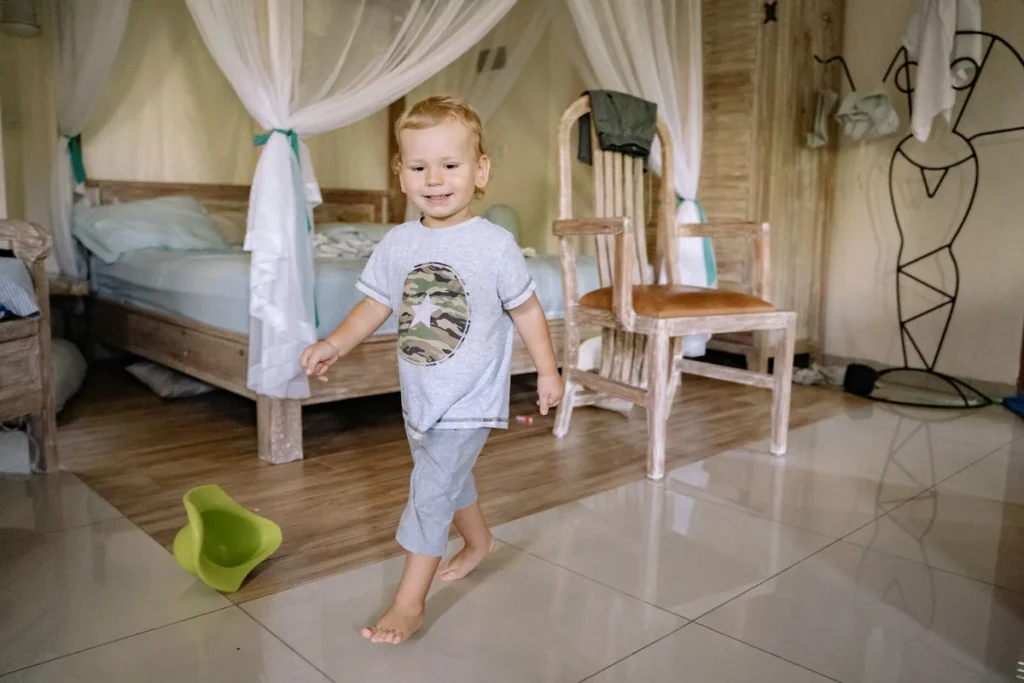
Your toddler hides behind the sofa to do a poo, then comes back and tells you the nappy is dirty. Your friend’s child, the same age, is already using the potty. You wonder whether you are starting too late, too early, or missing something obvious. Most parents of two-year-olds have had exactly this thought, usually while changing yet another nappy. The truth is simpler than the worry: there is no single right age to start potty training, but there are clear signs that a child is ready. This potty training readiness signs checklist will show you the ten signs to look for, how many of them matter, and what to do first when they are there.
Readiness is not one skill. It is a small bundle of skills that arrive together: the body can hold wee for a while, the child notices what their body is doing, they can walk to the bathroom and pull their clothes down, and they want to copy the grown-ups. Some children show most of these signs at eighteen months. Others show them closer to three. Both are normal. What age to start potty training is the wrong question on its own — the better question is whether your child is showing the signs, and whether life at home is calm enough to begin.
What Potty Training Readiness Really Means
Before a child can use the potty on their own, they have to put several jobs together: feel the need to go, understand what that feeling means, remember where the potty is, get there in time, and tell you they need help. That is a lot for a two-year-old brain, which is why readiness is about thinking and talking as much as it is about the body. The American Academy of Pediatrics describes this clearly in its guide to the thinking and language skills behind toilet training, and it is worth a read if you want the full picture of what your child is learning.
The ages below are a rough guide, not a test. Most children start to show signs of bladder and bowel control between 18 and 24 months, and in the United States the average age toilet training begins is between two and three years. Most children are trained by four. But averages hide the spread: a child who shows no signs at two is not behind, and a child who shows signs at eighteen months is not ahead. They are just on their own timetable, and the signs below are how you read it.
The 10 Signs Your Toddler May Be Ready
You do not need all ten signs. Most children are ready to start when they show several of them together, especially a mix of body signs, thinking signs and interest. Read the list slowly and tick off the ones you have actually seen, not the ones you hope are there.
| Sign | What it looks like at home | What it tells you |
|---|---|---|
| Stays dry for two hours or more | The nappy is dry after a nap, or dry for a couple of hours in the day | The bladder can hold wee for a useful stretch |
| Knows when they are going | Goes quiet, squats, grunts, freezes mid-play, or hides behind the sofa | They can feel the signal from their body |
| Tells you the nappy is wet or dirty | Points at the nappy, says “wee” or “poo”, or brings you a clean nappy | They connect the feeling with words |
| Dislikes a wet or dirty nappy | Pulls at the nappy, asks to be changed, or gets upset when wet | They want to be clean and dry |
| Has bowel movements at regular times | Poo comes at roughly the same time most days, often after a meal | You can plan potty sits around a pattern |
| Can walk to the bathroom and sit down | Walks there on their own and climbs onto the potty or a step | They can get there in time, without being carried |
| Can pull clothes up and down | Pulls trousers or pants down with a little help, and tries to pull them up | They can manage the practical part |
| Follows simple instructions | Understands “bring me your shoes” or “sit on the potty” | They can follow the steps of the routine |
| Shows interest in the potty or toilet | Follows you into the bathroom, watches, asks questions, wants to sit on it | They want to copy what the grown-ups do |
| Asks for “big kid” underwear | Wants to wear pants like an older brother, sister or friend | They are proud of growing up, and that pride helps |
Three of these signs matter more than the rest, because they are the ones that make the whole thing work: staying dry for a couple of hours, knowing when they are going, and being able to tell you about it in some way — with words, a point, or a sound. A child who has those three is usually ready to try, even if they cannot yet pull their trousers down on their own. That is a skill you can practise together. A child who has none of the three will usually find it much harder, and waiting a few weeks is kinder than pushing on.

How Many Signs Do You Need?
There is no pass mark, and no quiz score that says “start now”. That is how to use this potty training readiness signs checklist: look for a pattern, not a perfect score. If your child shows five or six signs, and they include at least one body sign and one interest sign, it is a good time to try. If they show two or three, it is probably worth waiting and watching for a few more weeks. And if they show none at all, put the potty away for now — not for ever, just until the signs arrive.
Is my toddler ready for potty training quiz is a question parents type into search boxes a lot, and the honest answer is that no quiz can decide it for you. You know your child better than any list. The signs above are a way of organising what you already see every day: the dry nappy after a nap, the hiding behind the sofa, the interest in the bathroom. Trust what you have seen with your own eyes over the last few weeks, not what another child the same age is doing.
One more thing matters as much as the signs: the timing for the family. The American Academy of Pediatrics suggests holding off during a house move, a new baby, a serious illness or another big change at home, and the same advice holds here. A calm fortnight with no nursery start, no holiday and no new baby is the best time to begin. If life is unsettled right now, the signs will still be there in a few weeks, and starting then will be easier for everyone.
A Simple Way to Start When the Signs Are There
Start by making the potty familiar, not by making it a test. Put the potty in the bathroom where your child can see it, and let them sit on it with their clothes on, for a minute or two, a few times a day. This is the first step of the potty training readiness signs checklist in action: you are checking that sitting feels safe before you ask for anything more. Read a book together while they sit, or sing a song. Our guide to sensory play ideas for toddlers at home has plenty of calm, hands-on play that works well for these short sitting times, because a child who is playing is a child who will stay put.
Then build a simple routine around the times your child is most likely to need to go: first thing in the morning, after meals, and before bed. Sit them on the potty at those times, for just a few minutes, and keep it relaxed. If nothing happens, say “never mind, we will try again later” and move on. If something does happen, celebrate it warmly — a big smile, a clap, a “you did it!” — and that is the reward. The praise is the point; the child did something new and hard, and they should know you noticed.
A sticker chart helps many families, and it is simple to make: a piece of paper on the bathroom wall, and one sticker each time your child sits on the potty or uses it. Counting the stickers together each evening turns it into a little game, and the counting itself is good practice — our Christmas-themed learning activities for toddlers are full of the same kind of counting and matching games, if you want more ideas in that style. Keep the chart about sitting and trying, not only about succeeding, so the child is rewarded for the habit and not punished by an empty day.
Teach the whole routine, not just the sitting: pull pants down, sit, wipe, flush, wash hands. Handwashing is part of it from the first day, and children love the tap and the bubbles. If you want calm, screen-free time to practise all of this in, our 25 screen-free indoor activities for toddlers on cold days has quiet indoor ideas that leave room for the slow, unhurried mornings a new routine needs.

What to Do — and What to Avoid
| Do | Don’t |
|---|---|
| Start when several signs are there together | Start because another child the same age has started |
| Let them sit with clothes on first, to get used to it | Force them to sit, or hold them there when they cry |
| Keep potty sits short — a few minutes is enough | Make them sit for a long time “until something happens” |
| Praise sitting, trying and telling you | Only praise a wee or a poo in the potty |
| Use a sticker chart for the habit | Use sweets or big presents as the only reward |
| Stay calm and matter-of-fact about accidents | Scold, shame or punish an accident |
| Keep the same words every time: “potty time”, “wee”, “poo” | Change the words, or use baby talk one day and grown-up words the next |
| Pause and try again in a few weeks if it is not working | Push on for weeks when your child is distressed |
The “don’t” column is the one that matters most. Potty training works when a child feels safe and proud, and it stalls when a child feels pressured or afraid. A child who is scared of the potty will hold wee in, and a child who is scolded for accidents will hide them instead of telling you. If you find yourself getting frustrated, that is a sign to pause, not to push harder. The potty will still be there next month, and so will your child.
Accidents Are Part of It
Accidents are not failures. They are how a child learns where the edge of their control is, and every child who has ever been potty trained has had them — usually a lot of them, usually in the most awkward places. Expect accidents for weeks, even months, after the first successes. A child who is dry at home may still have accidents at nursery, on a car journey, or when they are tired, excited or busy playing. That is normal, and it does not mean the training has failed.
When an accident happens, keep your voice calm and your words short: “Oh, you had an accident. Let’s get you cleaned up.” Change the clothes, clean up together without a fuss, and move on. Do not ask why it happened, and do not make the child say sorry. The child already knows it happened. What they need to learn is that telling you next time is safe, and that accidents are not a disaster.
Regression is normal too. A child who was dry for a month may start having accidents again when a new baby arrives, when they start nursery, when the family moves house, or when they are ill. That is not a step backwards in the long run — it is a child coping with a big change the only way they can. Go back to the calm routine, put the sticker chart back up, and give it time. If the accidents go on for a long time, or your child seems in pain or very distressed, talk to your doctor.

When to Wait a Little Longer
Sometimes the kindest thing is to wait. If your child shows few of the signs, if they cry or panic at the sight of the potty, if they are going through a big change at home, or if you are finding it hard to stay patient, it is better to pause. Put the potty away where they can still see it, keep talking about it lightly, and try again in three or four weeks. Most parents who pause and retry find the second try much easier, because the child has grown into the signs in the meantime.
There are also a few times to talk to your doctor rather than just waiting: if your child is past three and shows none of the signs at all, if they seem to be in pain when they wee or poo, if they are holding wee in for a very long time, or if you are worried for any other reason. A doctor would far rather hear a worry that turns out to be nothing than miss a problem that needed help. And if your doctor says your child is fine, believe them, and keep doing the same calm things — you have still done the right thing by asking.
Night-time dryness is a different job from daytime dryness, and it usually arrives later — sometimes a year or more later. It depends on a hormone that helps the body hold wee overnight, and no amount of practice or sticker charts can hurry that along. Do not compare a child who is dry in the day but wet at night with a child who is dry at both. Keep the nappy at night until it is dry most mornings, and treat nights as a separate, slower milestone.

Frequently Asked Questions
What age should I start potty training? Most children show the first signs between 18 and 24 months, and most families start between two and three years. But age alone is not the guide — the signs are. A child who shows several signs at twenty months is more ready than a child who shows none at three years.
How long does potty training take? It varies a lot. Some children are mostly dry in the day within a few weeks of starting. For others it takes a few months, with accidents along the way. Both are normal. Night-time dryness usually takes longer, and is a separate milestone from daytime dryness.
Should I use a sticker chart? Yes, if your child likes it. A simple chart with one sticker for each sit or try works well, because it rewards the habit rather than only the result. If your child loses interest in the chart, drop it — the praise and the routine matter more than the stickers.
What if my child refuses to sit on the potty? Do not force it. Let them sit with clothes on, let them watch you use the toilet, read a book about it together, and let them choose their own potty or pants. If they still refuse after a couple of weeks, pause and try again later. Refusal is usually a sign that the timing is wrong, not that the child is being difficult.
Should I train for wee and poo at the same time? Most children learn to wee in the potty first, and poo comes a little later — sometimes weeks later. Many children prefer to poo in a nappy even when they wee in the potty, and that is normal. Let them keep the nappy for poo for a while if that is what they need, and the rest usually follows.
Ready Is a Pattern, Not a Date
Your child does not need to be ready on a particular birthday, and you do not need to get it perfect the first time. What matters is the pattern: a child who stays dry for a while, notices what their body is doing, can tell you about it, and wants to be a big kid. Once you have worked through the potty training readiness signs checklist and you can see that pattern in your own child, the next step is small — a potty in the bathroom, a few minutes of sitting, a sticker, and a lot of patience. And if the pattern is not there yet, the kindest step is the simplest one: wait a few weeks, keep watching, and try again when the signs arrive. If you are expecting again, our first trimester checklist week by week has simple tasks for weeks 4 to 12.
This article is general information for parents, not medical advice. Every child develops at their own pace, and if you are worried about your child’s toileting, health or development, talk to your doctor or health visitor.


Leave a Reply